
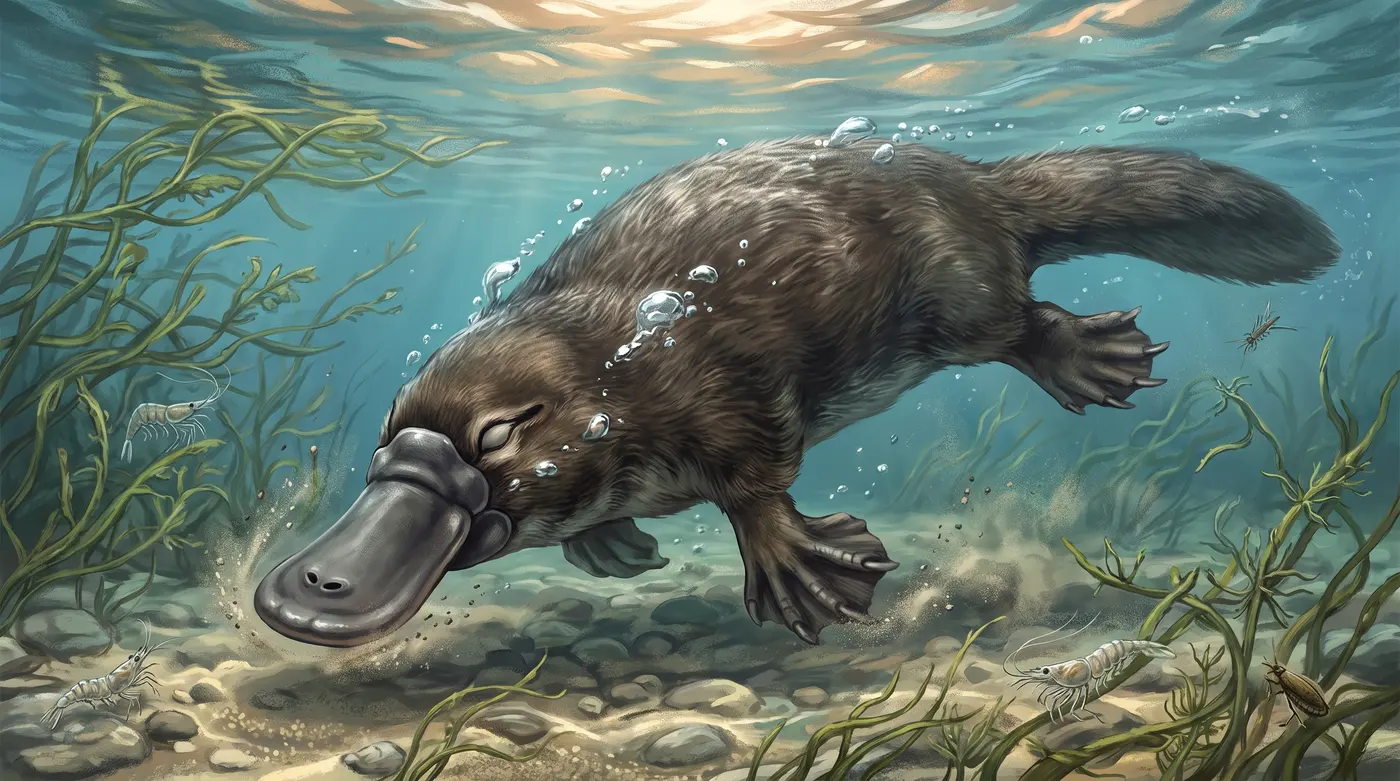
- Status: Threatened
- Rivers and streams of eastern Australia and Tasmania
Numbers
- Weight
- 3,3 lbfrom under 2 pounds to over 4.5 pounds; males are about one third larger than females
- Length
- 14 infrom 12 to 16 inches, plus a tail of 4 to 6 inches
- Lifespan
- 10 yearsup to 12 years in the wild
- Body temperature
- 90 °Fcompared to 100 °F in placental mammals
- Sex chromosomes
- 10 chromosomesfive pairs, compared to just one pair in other mammals
- Burrow length
- 65 ftbreeding burrows dug by the female, sealed with plugs
Ten fun facts
adults have no teeth, as babies are born with three-cusped molars but shed them as they grow older.
it walks with its legs at the sides of its body like a reptile, rather than underneath like other mammals.
it has a single body opening called a cloaca to lay eggs, urinate, and pass waste, just like birds and reptiles.
the female digs breeding burrows up to sixty-five feet long and seals them at intervals with soil plugs.
male venom is not fatal to humans, but it can easily kill a dog, and there is no known antidote.
it can hunt for hours in water below forty degrees Fahrenheit while keeping its body temperature at ninety degrees.
its fur glows under ultraviolet light, a biofluorescent trait shared with opossums and flying squirrels.
it has extra bones in its shoulder girdle, including an interclavicle bone that no other living mammal possesses.
it has been the official mammal emblem of the Australian state of New South Wales since 1971.
early British settlers called it a water mole before it became widely known as the duck-billed platypus.
The quiz answers
Five questions about this animal. Pick an answer and find out if it is the right one.
Question 1 of 5
What makes the platypus different from almost all other mammals?
Question 2 of 5
How does it locate prey underwater?
Question 3 of 5
What is the average body temperature of a platypus?
Question 4 of 5
Where is the male's venomous spur located?
Question 5 of 5
How many sex chromosomes does the platypus have?
Try it yourself
Measure fourteen inches on a tape measure to see the body length of an adult platypus without its tail. Add another five inches to account for the tail.
Put on a blindfold and try to identify three objects using only your hands, just like a platypus hunting underwater with its eyes closed.
Unroll sixty-five feet of string in your yard or hallway to see the full length of a breeding burrow dug by a female platypus.
Data from Wikidata (Q15343) and Wikipedia (Platypus).