
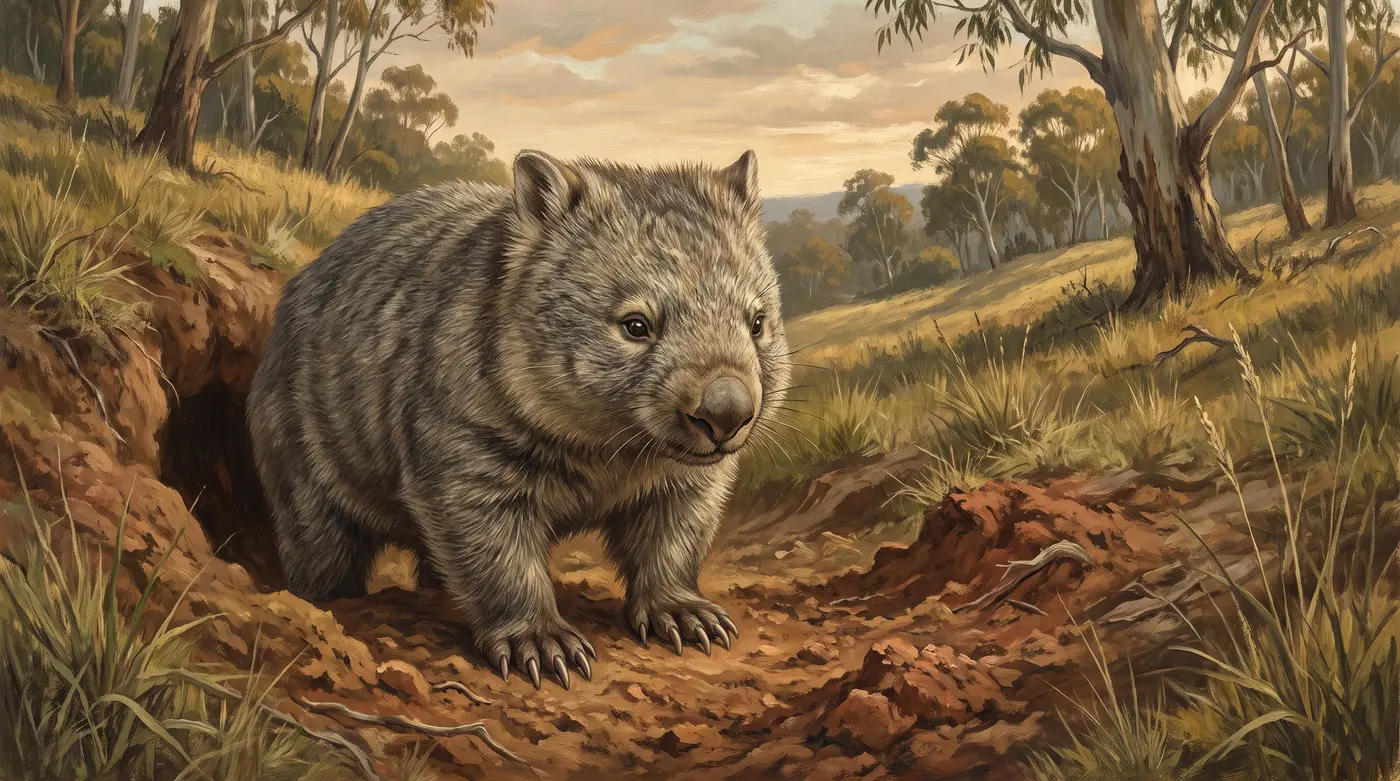
- Status: Safe
- Southern and eastern Australia, Tasmania, and Bass Strait islands
Numbers
- Weight
- 60 lbmainland subspecies average, up to 77 lb in the largest individuals; in Tasmania the average is 44 lb
- Length
- 40 inmainland subspecies; up to 47 in in larger individuals, 33 in in Tasmania, 30 in on Flinders Island
- Lifespan
- 15 years11 to 15 years in the wild
- Burrow length
- 65 fttunnels from 6 to 65 feet, with many side branches and multiple entrances
- Maximum weight
- 77 lblargest individuals of the mainland subspecies
- Time spent in pouch
- 11 monthsfrom nine to eleven months, weighing up to 14 lb upon leaving
Ten fun facts
it is the only marsupial in the world whose teeth grow throughout its entire life, one pair above and one below.
its droppings are cube-shaped and do not roll off the rocks where the animal deposits them.
it changes burrows every one to nine days, selecting among several tunnels dug throughout its home territory.
its underground burrows host reptiles, rodents, rabbits, echidnas, wallabies, birds, and koalas, which use them for shelter.
it is often called the naked-nosed wombat because of its large snout completely lacking hair.
between 1926 and 1966 in Victoria it was treated as an agricultural pest with a bounty on every specimen.
in Victoria the species had no legal protection until 2020, nearly a century after culling began.
about one million three hundred thousand common wombats remain, but over two-thirds live on islands like Tasmania.
an extinct species of the same genus, Vombatus hacketti, weighed about sixty-six pounds and vanished in the late Pleistocene.
the Flinders Island subspecies is the smallest, measuring about thirty inches long, and remains classified as vulnerable.
The quiz answers
Five questions about this animal. Pick an answer and find out if it is the right one.
Question 1 of 5
What makes the common wombat's teeth unique?
Question 2 of 5
Which direction does the wombat's pouch open?
Question 3 of 5
How long can its burrows be?
Question 4 of 5
What does the common wombat eat?
Question 5 of 5
How many babies are born at a time?
Try it yourself
Lay out sixty-five feet of rope in the yard and fold it in a zigzag pattern: that is how long a wombat burrow can be.
Fill a backpack up to sixty pounds and try moving it with an adult's help: that is the average weight of a common wombat.
Mark one day on the calendar every nine days: that is how often a wombat switches burrows within its own territory.
Data from Wikidata (Q752436) and Wikipedia (Common wombat).