
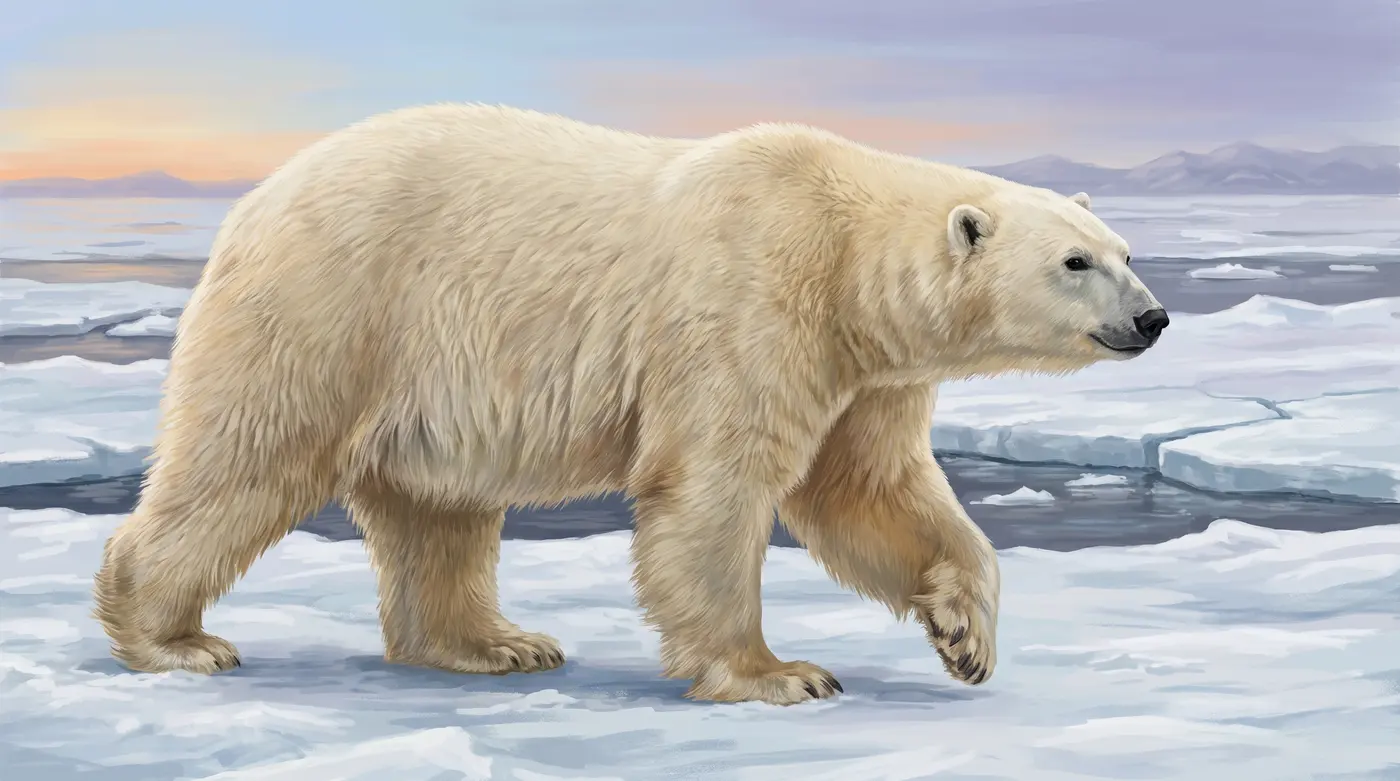
- Status: Threatened
- Sea ice and Arctic coasts of Greenland, Canada, Alaska, Russia, and Svalbard
Numbers
- Weight
- 1000 lbmales from 660 to 1,760 lb, females from 330 to 660 lb
- Length
- 7,4 ftmales from 6.5 to 8.2 ft, females from 5.9 to 6.5 ft
- Height
- 4,8 ftat the shoulder, from 4.3 to 5.2 ft
- Lifespan
- 25 years20 to 25 years in the wild
- Speed
- 25 mphestimated value, normal walking pace 3.4 mph
- Continuous swim
- 96 mirecorded average over 3.4 days nonstop
- Maximum recorded weight
- 2210 lbmale shot in Alaska in 1960
Ten fun facts
its skin is black rather than white, which helps absorb heat from sunlight filtering through its thick fur.
the guard hairs are hollow and transparent, so the fur only appears white because it scatters incoming light.
the largest recorded specimen was a male shot in Alaska in 1960 that weighed two thousand two hundred pounds.
before fasting periods it can increase its body mass by up to fifty percent by building up thick fat reserves.
a study recorded bears swimming nonstop for three point four days, covering an average distance of ninety-six miles.
only pregnant females hibernate, while all other polar bears remain active throughout the entire freezing polar winter.
it has dichromatic vision and lacks green-sensitive cones, but it sees exceptionally well in low light conditions.
its kidneys are divided into many small lobes to filter out the salt ingested when eating prey.
oily secretions keep its fur from freezing, allowing it to dry off quickly with a simple shake after swimming.
up to nine percent of the ABC Islands brown bear genome comes from ancient interbreeding with the polar bear.
The quiz answers
Five questions about this animal. Pick an answer and find out if it is the right one.
Question 1 of 5
What color is the skin under a polar bear's fur?
Question 2 of 5
How long can it swim without stopping?
Question 3 of 5
Which polar bears hibernate?
Question 4 of 5
What is its main prey?
Question 5 of 5
Why does shrinking sea ice threaten this animal?
Try it yourself
Dip one finger into ice water, then repeat after wrapping it in a bag full of butter to understand how a four-inch fat layer works.
Measure out eight feet on the floor with a tape measure and lie down next to the line to see the length of an adult male.
Find a place ninety-six miles from your home on a map to picture the average nonstop swim recorded by researchers.
Data from Wikidata (Q33609) and Wikipedia (Polar bear).