
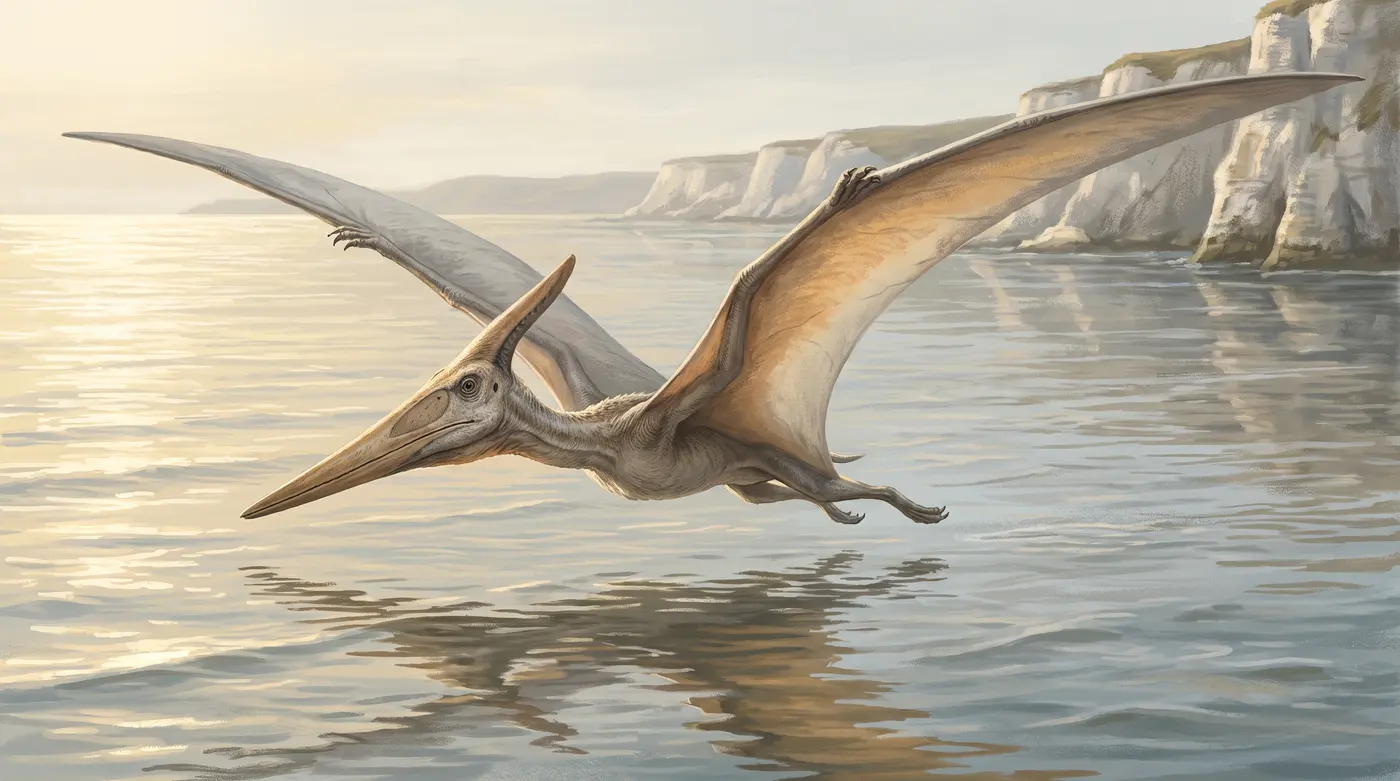
- Status: Extinct
- Fossils in Kansas, Alabama, Nebraska, Wyoming, and South Dakota
- Extinct
Numbers
- Weight
- 77 lbfrom 44 to 110 lb
- Length
- 6 ftfrom 5 to 6.5 ft (body length)
- Lifespan
- 86 million years agoLate Cretaceous, from about 86 to 75 million years ago; the genus lasted for more than 4 million years
- Wingspan
- 24 ftspecimen from the Pierre Shale Formation, perhaps of a different genus; the average for adult males is 18 feet
- Known fossils
- 1200 specimensmore than for any other pterosaur, although less than half are fairly complete
- Lower jaw
- 4 ftmeasured in the species Pteranodon sternbergi
Ten fun facts
pterosaurs are not dinosaurs because dinosaurs belong to Saurischia or Ornithischia, while flying reptiles remain entirely outside both of these groups.
the very first fossils collected by Marsh contained teeth from a prehistoric fish, which he mistakenly attributed to the new flying reptile.
Marsh gave Pteranodon a name that means toothless wing because it was the very first flying reptile ever discovered without any teeth.
the first skull of Pteranodon was found on May 2, 1876, along the Smoky Hill River in Kansas by Samuel Wendell Williston.
female Pteranodon specimens had small rounded crests and wide hips, whereas males possessed large impressive crests and narrower hips for flight.
one massive specimen from the Pierre Shale Formation had a wingspan of twenty-four feet, though it might belong to a different genus.
many researchers believe Pteranodon had a pouch under its beak similar to a pelican, a theory supported by certain fossil throat impressions.
the tail of Pteranodon measured only about three point five percent of its wingspan, an unusual proportion for a pterodactyloid pterosaur.
researchers Witton and Habib noted that the highest weight estimates for Pteranodon would only work if the creature were made of aluminum.
for several decades, the name Pteranodon became a convenient label for almost any toothless jaw from a flying reptile found anywhere.
The quiz answers
Five questions about this animal. Pick an answer and find out if it is the right one.
Question 1 of 5
Was Pteranodon a dinosaur?
Question 2 of 5
What does the name Pteranodon mean?
Question 3 of 5
What was the average wingspan of an adult male?
Question 4 of 5
Why is the weight of Pteranodon still uncertain?
Question 5 of 5
What was the head crest likely used for?
Try it yourself
Unroll a tape measure on the floor to eighteen feet: that is the average wingspan of an adult male Pteranodon stretching its wings.
Draw a chalk line four feet long, which equals the lower jaw of Pteranodon sternbergi, and compare that length with your own height.
Fill a backpack up to forty-five pounds, the lowest weight estimate for this animal, and imagine it lifted by twenty-four feet of wings.
Data from Wikidata (Q245060) and Wikipedia (Pteranodon).