
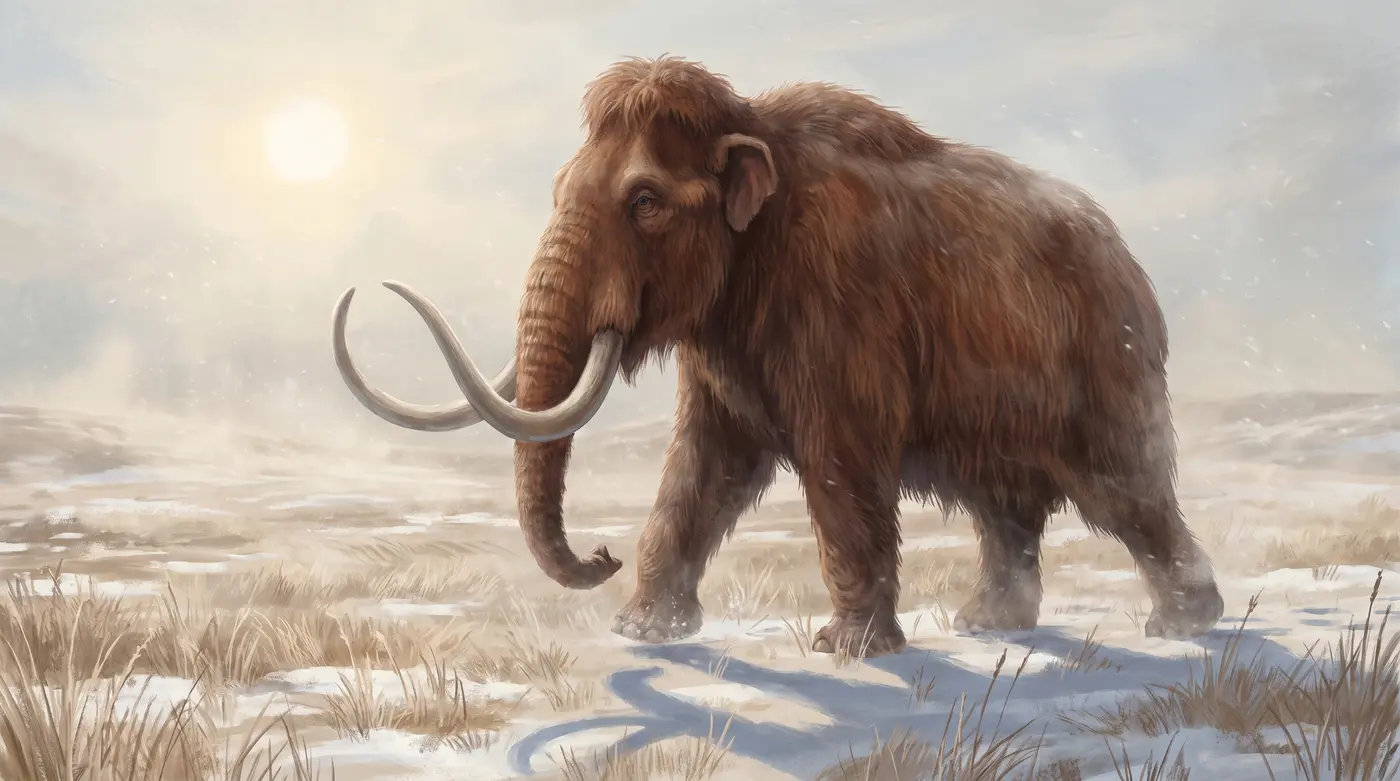
- Status: Extinct
- Fossils and frozen carcasses in Siberia, Europe, and North America
- Extinct
Numbers
- Weight
- 13000 lbmale average between 5 and 6.5 short tons; full range for males is from 4.3 to 9 short tons, females are between 3 and 4.4 short tons; Wikidata does not report mass
- Length
- 13 ftExtinct. Length estimate based on well-preserved fossil skeletons.
- Height
- 10,3 ftshoulder height, upper limit of male average; females are between 7.5 and 8.5 ft and the Siegsdorf specimen reached 11.5 ft
- Lifespan
- 60 yearsestimated around 60 years
- Tusks
- null inthe material confirms long curved tusks but never indicates their length: slot remains empty until a source is found
- Longest hair
- 35 inguard hairs on flanks and belly; on the back they were about 12 in long
- Subcutaneous fat
- 4 inbeneath skin between 0.5 and 1 in thick, like modern elephants
Ten fun facts
its closest living relative is not the African elephant but the Asian elephant, which split from it between 5.8 and 7.8 million years ago.
it used four molars at a time, replaced six times over its lifetime, and could reach sixty years of age.
the tail of the Berezovka mammoth measured just fourteen inches and had 21 vertebrae, compared to 28 to 33 in modern elephants.
at the tip of its trunk it had a pointed lobe about four inches long and a wider lower thumb measuring two inches.
the woolly mammoth and the African elephant share between 98.55 and 99.40 percent of their entire genome.
DNA was successfully extracted from hair follicles of one individual from 20,000 years ago and another from 60,000 years ago.
in 2021 scientists sequenced two teeth over one million years old, obtaining the oldest DNA ever recovered.
the number of ridges on molar teeth increased over mammoth evolution, with woolly mammoths having 26 while earlier species had only 8.
cave paintings showed a high dome-shaped head and a shoulder hump, features later confirmed by intact preserved skeletons.
preserved fur appears orange-brown, but this color was almost certainly altered over time as the pigments degraded.
The quiz answers
Five questions about this animal. Pick an answer and find out if it is the right one.
Question 1 of 5
What is the closest living relative of the woolly mammoth?
Question 2 of 5
How thick was the layer of fat under the skin?
Question 3 of 5
Why did it have very short ears and tail?
Question 4 of 5
When did the last populations disappear?
Question 5 of 5
What did it mainly feed on?
Try it yourself
Measure three feet of string and hang it on the wall. That was the length of hair on a woolly mammoth's flanks, with three-inch hair underneath.
Take a ruler and mark four inches. That was the maximum thickness of the layer of fat under the skin that kept this animal warm.
Use tape to mark a height of eleven and a half feet on a wall. The largest male specimens reached that height at the shoulder.
Data from Wikidata (Q3699044) and Wikipedia (Woolly mammoth).