
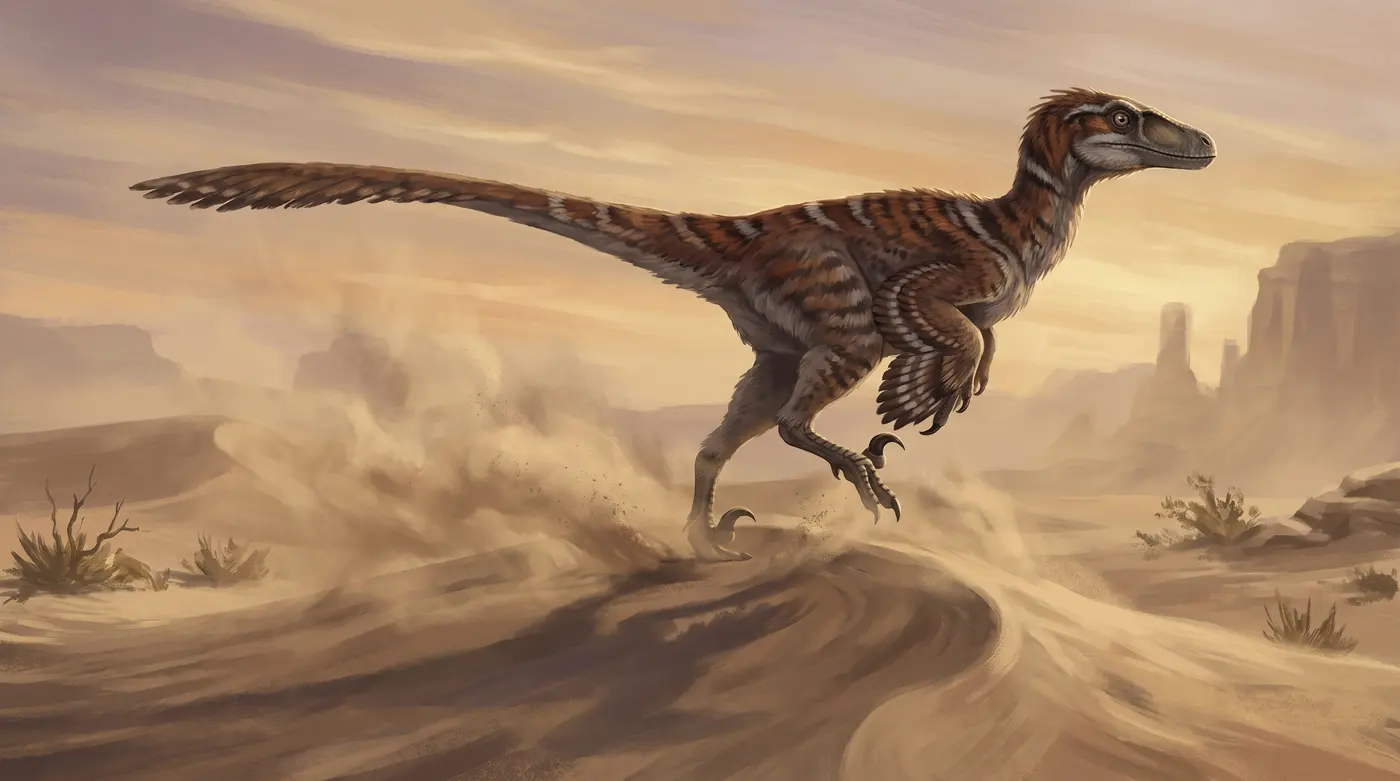
- Status: Extinct
- Fossils found in the desert of southern Mongolia, Djadochta Formation
- Extinct
Numbers
- Weight
- 33 lb33 to 44 lb
- Length
- 6,5 ftaverage length inferred from fossil remains
- Height
- 20 inmeasured at the hip, not at the head
- Lifespan
- 83 million years agoLate Cretaceous, Campanian: fossils are dated between 83 and 70 million years ago
- Teeth
- 28 teethtwenty-six to twenty-eight, curved and serrated on the back side
- Hip height
- 20 inmuch less than the animal shown in movies
- Sickle claw
- null inon the second toe; the material does not state its length
Ten fun facts
the sickle claw on the foot was mistaken for a hand claw by the team that found the first specimen.
it walked touching the ground with only its third and fourth toes while holding its curved clawed second toe raised.
its jaws held between twenty-six and twenty-eight curved teeth that were serrated only on the edge facing backward.
its feathers did not fossilize, but their anchor points left small knob impressions directly on the lower arm bones.
all known specimens come from a single geological formation in southern Mongolia known as the Djadochta Formation.
the Fighting Dinosaurs fossil preserves an individual and a Protoceratops locked together in the exact position they died.
sandstones without internal structures suggest that many animals were suddenly buried alive by massive collapsing sand dunes.
no fossil has ever been found alongside others of the same species, leaving pack hunting entirely without evidence.
the first specimen was described in 1924 by Henry Fairfield Osborn using a flattened yet complete fossil skull.
it belongs to the Maniraptora group, which is the exact same clade that includes avian dinosaurs and modern birds.
The quiz answers
The first one is the question printed in your book: here is the answer. The other four are extra.
Question 1 of 5★ this one is in your book
How tall was it at the hip?
Question 2 of 5
Where have all known specimens been found?
Question 3 of 5
What did it have on its second toe?
Question 4 of 5
Did it have feathers?
Question 5 of 5
Did it hunt in packs?
Try it yourself
Measure twenty inches up from the floor with a tape measure to mark the wall. That was the real hip height of this animal, unlike in the movies.
Stick six and a half feet of tape onto the floor and lie down next to it. That was the total length of an adult, including its tail.
Count twenty-eight dried beans and line them up on a sheet of paper. That was the maximum number of teeth in its jaws.
Data from Wikidata (Q1420827).