
- Status: Safe
- Tropical and temperate deep ocean waters worldwide, including the Mediterranean
Numbers
- Weight
- 0,9 oz0.7 to 1.1 oz
- Length
- 24 in12 to 24 in
- Lifespan
- 25 years15 to 30 years
- Depth
- 10000 ftduring the day between 1,600 and 10,000 feet, at night near the surface
- Mouth lights
- 350 light organsused to attract prey
- Mouth opening
- 90 degreesallows prey up to 63 percent of its own body size
Ten fun facts
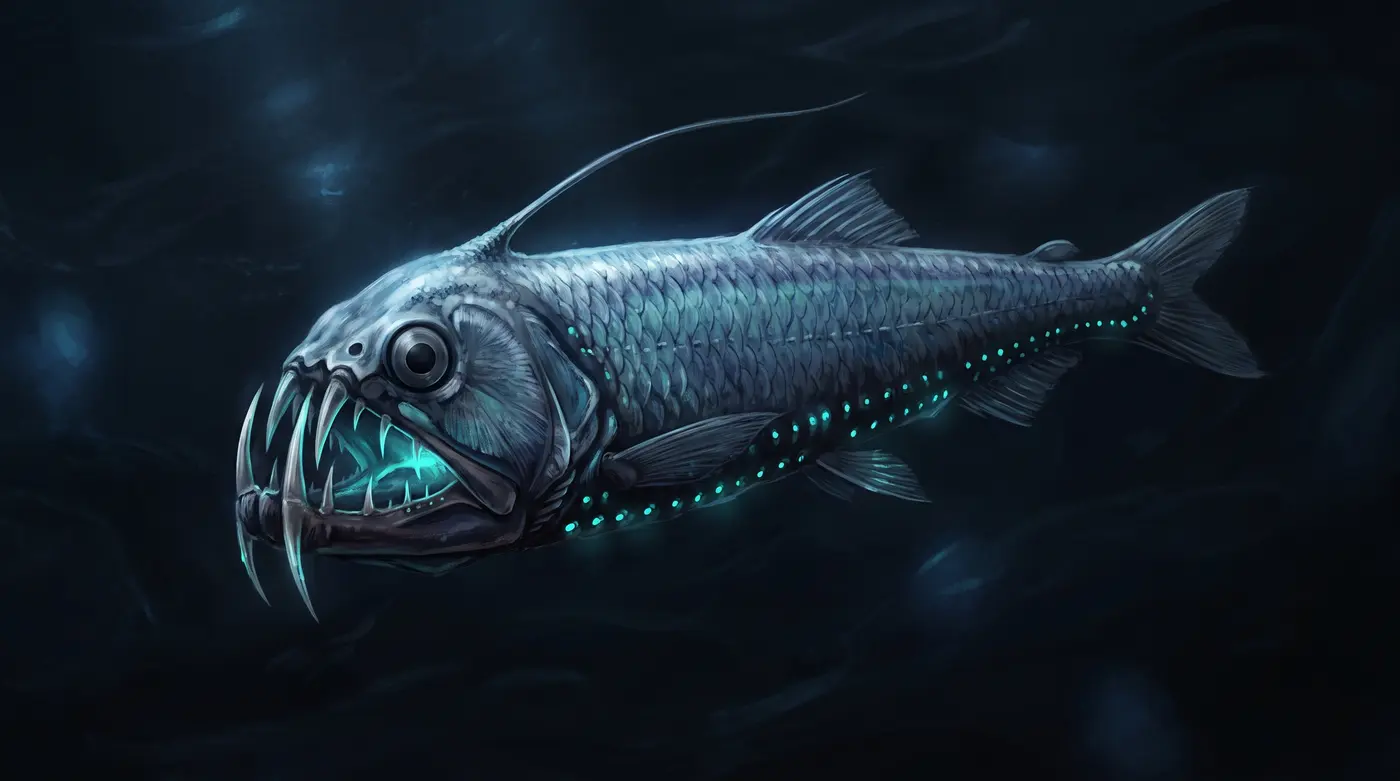
its teeth cannot bend backward because they are fixed to the jawbone, so it must open its mouth wide to catch prey.
when its mouth is closed, the overlapping teeth form a cage that prevents smaller prey from swimming away into the dark.
the first tooth in its upper jaw is straight and sharp for wounding, while the second tooth is curved to hold prey.
it can arch the long ray of its top fin in front of its mouth and use it as a lure to attract prey.
it adjusts the brightness of its belly lights to erase its shadow, hiding from predators that swim beneath it in the dark.
it lacks a gas-filled swim bladder, and the bones in its tail and scales are only lightly hardened with calcium.
in a study of twenty-eight fish species found inside its stomach, eighteen of them turned out to be deep-sea lanternfish.
only young viperfish shorter than five inches have crustaceans in their stomachs, while fully grown adults feed almost exclusively on fish.
in the central Mediterranean Sea, it is a primary meal for Atlantic bluefin tuna, and its remains appear in whale stomachs.
scientists have known about this species since 1801, when two German researchers described it in a vast catalog of fishes.
The quiz answers
The first one is the question printed in your book: here is the answer. The other four are extra.
Question 1 of 5★ this one is in your book
Why can the viperfish not close its mouth?
Question 2 of 5
How many light organs are inside its mouth?
Question 3 of 5
Where does the viperfish go at night?
Question 4 of 5
How long is a viperfish?
Question 5 of 5
What are the belly lights used for?
Try it yourself
Open a pair of compasses or two pencils to a ninety-degree right angle. That is how wide a viperfish opens its mouth to swallow large prey.
Measure twenty-four inches with a tape measure, then calculate sixty-three percent of that length to find the size of the biggest prey it can swallow.
Mark one meal on a calendar every twelve days for three months. Count your marks to see how few times a viperfish eats in that period.
Data from Wikidata (Q849341) and Wikipedia (Sloane's viperfish).