
- Status: Threatened
- Western Pacific, from the Andaman Sea to the Fiji Islands
Numbers
- Weight
- 2,9 lbfrom 2 to 3 pounds
- Length
- 10 inshell diameter in exceptional specimens; the Sulu Sea subspecies reaches 6 inches
- Lifespan
- 20 yearsup to 20 years in the wild
- Depth
- 2000 ftlimit beyond which the shell implodes
- Number of cirri
- 90 cirrifilaments without suction cups instead of arms
- Incubation
- 15 monthsfrom 9 to 15 months depending on water temperature
Ten fun facts
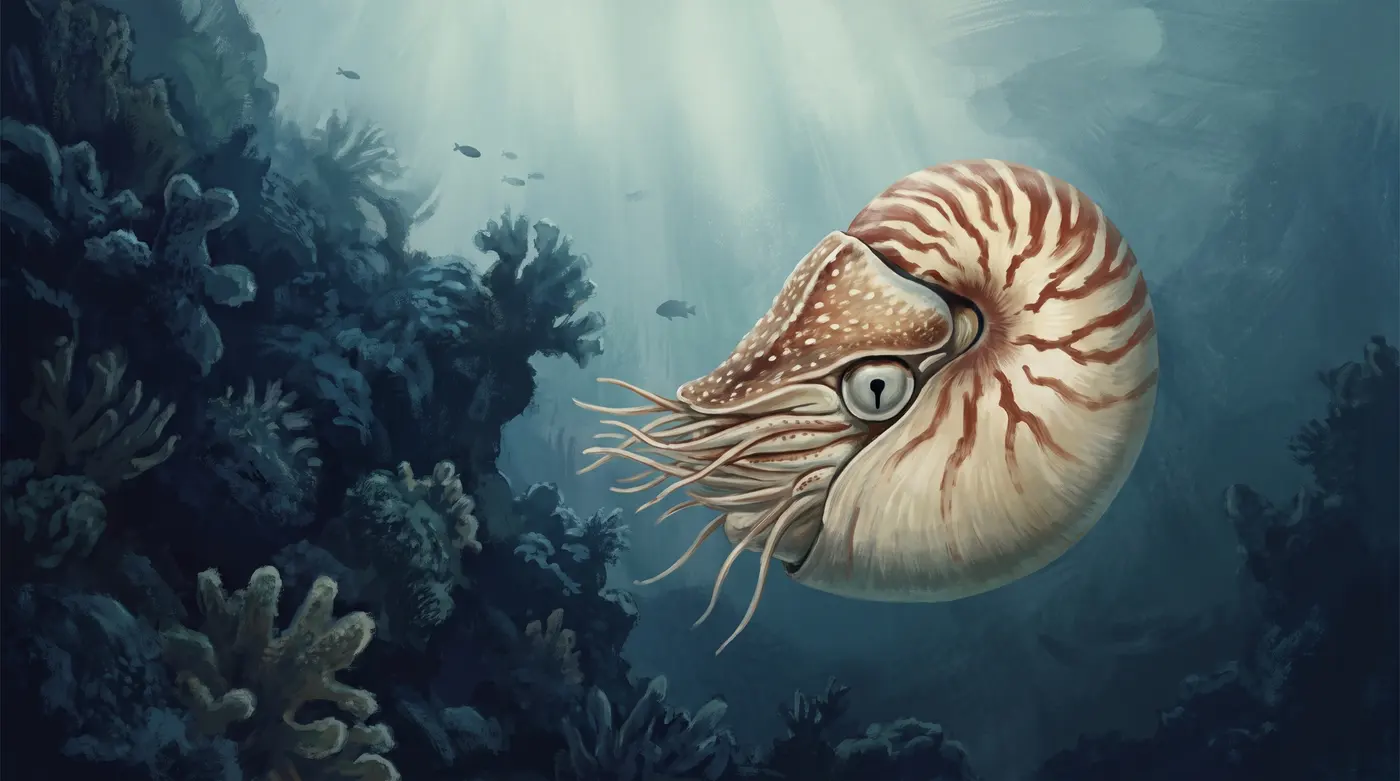
its eyes lack lenses and function like a pinhole camera with a tiny hole instead of a lens.
it has about ninety cirri without suction cups, which are very different from octopus and squid arms.
two organs called rhinophores located near its eyes allow it to detect chemicals dissolved in the water.
its shell is light below and dark above, blending in with the dark from above and light from below.
its eggs take nine to fifteen months to hatch, depending on the temperature of the water around them.
unlike other cephalopods, it lacks a larval stage and hatches from the egg with a fully formed shell.
its eggs have never been observed in the wild, so almost everything we know comes from public aquariums.
the name Nautilus pompilius actually groups together dozens of distinct species that are not yet officially separated.
its shell spiral is often confused with the golden ratio, but its average ratio is actually lower.
in 2016 it was added to CITES Appendix II to restrict the international trade of its shells.
The quiz answers
Five questions about this animal. Pick an answer and find out if it is the right one.
Question 1 of 5
What are the empty chambers of the shell used for?
Question 2 of 5
What happens to the shell below 2,000 feet?
Question 3 of 5
What are the eyes of the nautilus missing?
Question 4 of 5
Why is the nautilus threatened?
Question 5 of 5
About how many cirri does a nautilus have?
Try it yourself
Puncture an index card with a pin and look through it in a bright room to see roughly how this animal views its world.
Push an empty closed plastic bottle underwater in the sink to feel the buoyant force that the shell chambers must control.
Measure ten inches on a ruler to visualize the diameter of the largest shells ever recorded, which were found in Indonesia and Australia.
Data from Wikidata (Q872853) and Wikipedia (Chambered nautilus).