
Japanese spider crab
Macrocheira kaempferi
The largest living arthropod on Earth
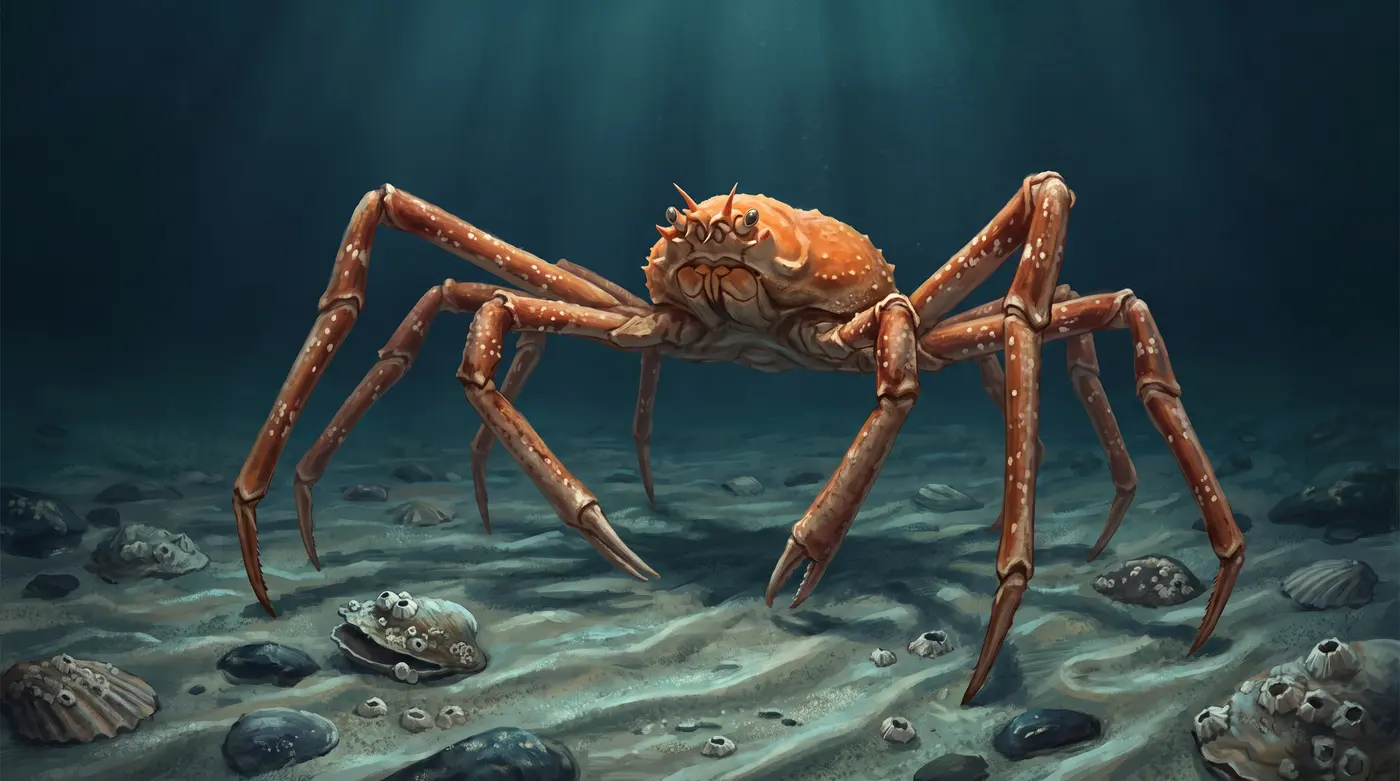
- Status: Unknown
- Sandy sea floors of the Pacific Ocean around the Japanese archipelago
Numbers
- Weight
- 44 lbmaximum value for an adult
- Length
- 15 inbody size; the legs span thirteen feet from claw to claw
- Lifespan
- 100 yearsaverage value indicated in the material
- Leg span
- 13 ftthe record among all living arthropods
- Depth
- 2600 ftmaximum depth; most often between 650 and 1,000 feet
- Open claws
- 10 ftonly in males, longer than the legs
Ten fun facts
that the Japanese spider crab is the largest living arthropod on Earth, bigger than any insect, spider, or other crustacean?
that all other species in its genus are known only from fossils, which is why it is called a living fossil?
that its body shell can measure sixteen inches long, but its leg span can reach up to thirteen feet wide?
that this giant crab has an average lifespan of about one hundred years, which is similar to a human centenarian?
that its body is bright orange, while its extremely long and thin legs are covered with distinct white spots?
that young crabs have hairy, spiky shells with long frontal spikes that gradually wear down as they grow older?
that it moves into shallower waters around one hundred sixty feet deep in spring to lay eggs, when fishing is banned?
that it usually lives between six hundred fifty and one thousand feet deep, but has been found down at two thousand six hundred feet?
that despite its massive size and intimidating appearance, this crab has a gentle nature and is often kept in public aquariums?
that it is considered a culinary delicacy in Suruga Bay, although its wild population has declined in recent years?
The quiz answers
Five questions about this animal. Pick an answer and find out if it is the right one.
Question 1 of 5
How far does an adult specimen measure from leg tip to leg tip?
Question 2 of 5
At what depth does it usually live?
Question 3 of 5
How long can it live?
Question 4 of 5
Why is it called a living fossil?
Question 5 of 5
What happens during spring?
Try it yourself
Stretch your arms out wide and have someone measure your arm span, which equals your height, then compare it to the thirteen feet of this crab.
Use masking tape to outline a square measuring thirteen feet on each side on the floor, because a single adult crab would fill that entire space.
Find a large cooking pot about sixteen inches wide, which is roughly the size of the crab's central shell, while everything else is just legs.
Data from Wikidata (Q273655) and Wikipedia (Japanese spider crab).