
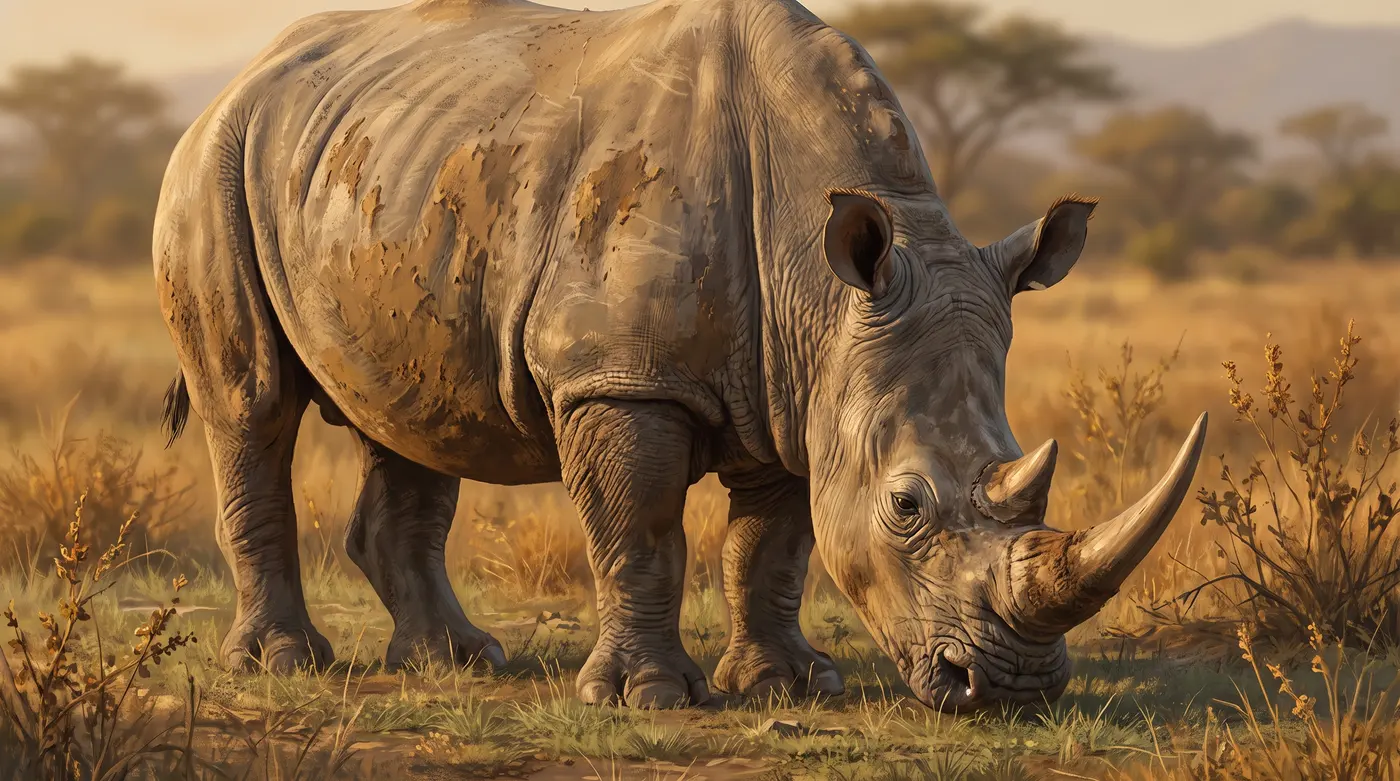
- Status: Threatened
- Large African savannas, today mostly in southern African reserves
Numbers
- Weight
- 6400 lbup to 8,800 lb in males
- Length
- 11 fthead-body, from 10.5 to 12 ft
- Height
- 6,4 ftat the shoulders, from 6 to 6.5 ft
- Lifespan
- 55 yearsfrom 50 to 60 years
- Front horn
- 67 inmaximum length
- Maximum weight
- 8800 lbexceptional males only
- Gestation
- 17 monthsfrom 16 to 17 months
Ten fun facts
the name white comes from a mistake because Afrikaans wyd means wide and described the lip, not the skin color.
in the Zulu language its name is Mkhombe, while the word white was given to it by Afrikaans settlers.
the front horn can reach five and a half feet, which is taller than many adult human beings.
an exceptional male can reach sixteen feet in length and weigh nearly nine thousand pounds, but these cases are rare.
this giant is the most social rhino species and forms small herds that sometimes exceed ten individuals.
gestation lasts sixteen or seventeen months and results in a single calf, while twin births are extremely rare.
when fleeing danger the calf runs in front of its mother rather than behind, staying protected from predators.
around 1880 only twenty-five or thirty individuals survived in Umfolozi, South Africa, putting the species on the brink.
during the 1960s Operation Rhino captured and relocated excess animals to repopulate other African parks and reserves.
Sudan, the last known northern male, died in Kenya in 2018, leaving behind only two surviving females.
The quiz answers
The first one is the question printed in your book: here is the answer. The other four are extra.
Question 1 of 5★ this one is in your book
Where does the name white come from for this animal?
Question 2 of 5
How long can the front horn grow?
Question 3 of 5
How long does the pregnancy last?
Question 4 of 5
How do calves behave when the herd flees?
Question 5 of 5
What happened to Sudan in 2018?
Try it yourself
Unroll a tape measure to five and a half feet and hang it on the wall to see the maximum length of the front horn. Compare it with your height.
Mark seventeen months from today on a calendar to visualize the duration of a pregnancy. See which season and year the birth would fall in.
Use masking tape to mark a line twelve feet long on the floor, then make a mark six feet high on the wall to see an adult's size.
Data from Wikidata (Q159918) and Wikipedia (White rhinoceros).