
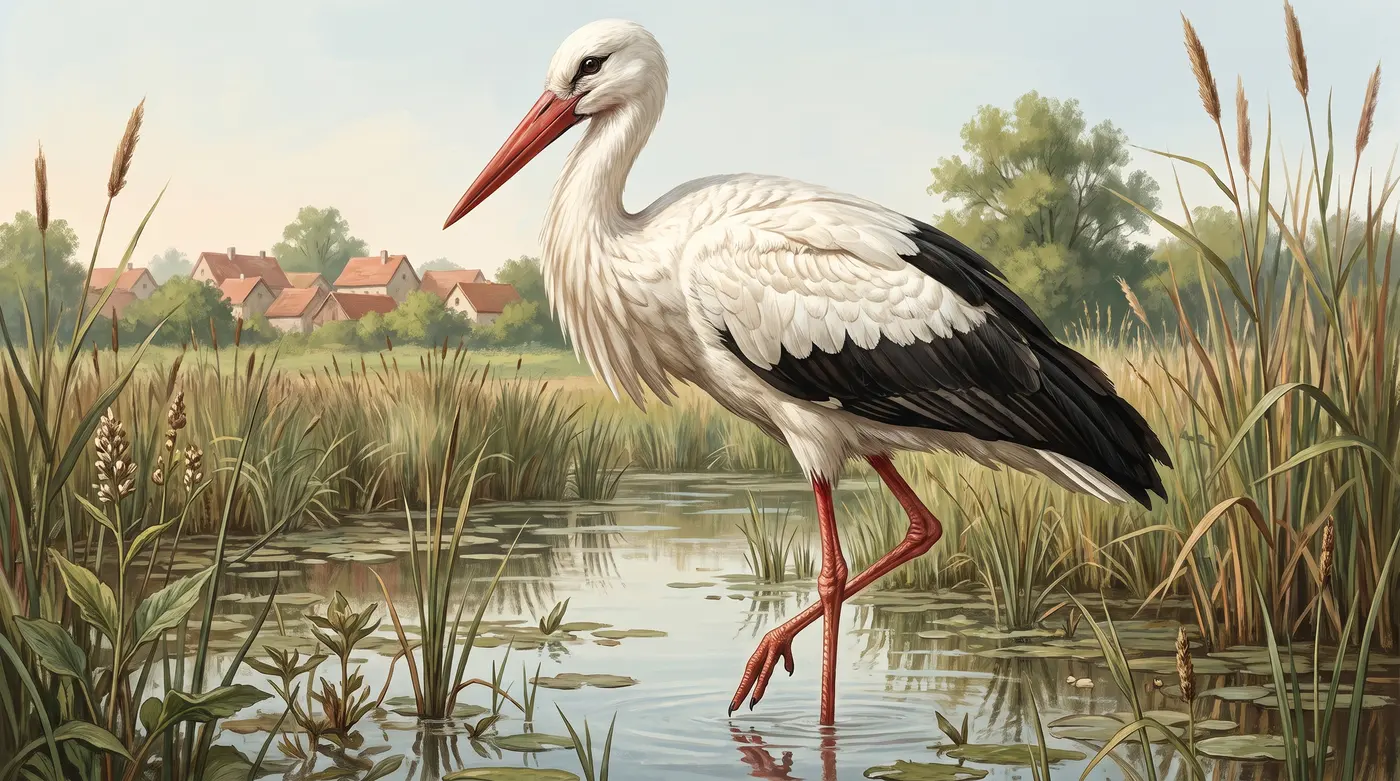
- Status: Safe
- Farmland and wetlands of Europe, winters in Africa
Numbers
- Weight
- 9 lbmales are on average slightly larger than females
- Length
- 43 infrom 40 to 45 inches, from the tip of the beak to the end of the tail
- Height
- 43 infrom 40 to 45 inches
- Lifespan
- 20 yearsup to 22 years in the wild
- Wingspan
- 7 ftfrom 5 to 7 feet, almost reaching 7 feet in some records
- Nest width
- 3 ftmore than 3 feet wide, reused for several years by the same pair
- First flight
- 70 dayschicks leave the nest between 58 and 64 days after hatching
Ten fun facts
it avoids flying across the Mediterranean Sea because warm thermal currents needed for gliding do not form over open water.
to reach Africa it flies around the sea, passing through the Strait of Gibraltar in the west or the Levant in the east.
the beak of a young bird is gray during its first months of life and gradually turns red as the years pass.
the stick nest measures more than three feet wide and the same adult pair reuses it for many consecutive years.
it is almost completely silent, but during courtship it rhythmically clatters the two halves of its beak together.
the eggs, usually four in number, hatch at different times after thirty-three or thirty-four days of incubation.
the chicks leave the nest after fifty-eight to sixty-four days, but their parents continue to feed them for weeks.
during the Middle Ages this species benefited from deforestation because open plains provided ideal hunting grounds.
it nested in Italy during Roman times, vanished in the seventeenth century, and returned naturally to Piedmont in the nineteen fifties.
in Calabria sixty-seven artificial platforms were installed on power pylons, which were insulated to prevent electrocution.
The quiz answers
The first one is the question printed in your book: here is the answer. The other four are extra.
Question 1 of 5★ this one is in your book
Why does it avoid flying across the Mediterranean?
Question 2 of 5
What color is an adult's beak?
Question 3 of 5
How wide is its nest?
Question 4 of 5
How does it make noise during courtship?
Question 5 of 5
When did it disappear from Italy?
Try it yourself
Look up the Strait of Gibraltar and the Levant on a map. Trace the two routes connecting Europe to Africa without crossing open sea water.
Tap two wooden spoons together with a steady rhythm. This mimics the clattering sound that these birds make using the two halves of their beaks.
Draw a circle three feet wide on the floor to match the minimum size of a nest. Try standing inside it together with a friend.
Data from Wikidata (Q25352) and Wikipedia (White stork).