
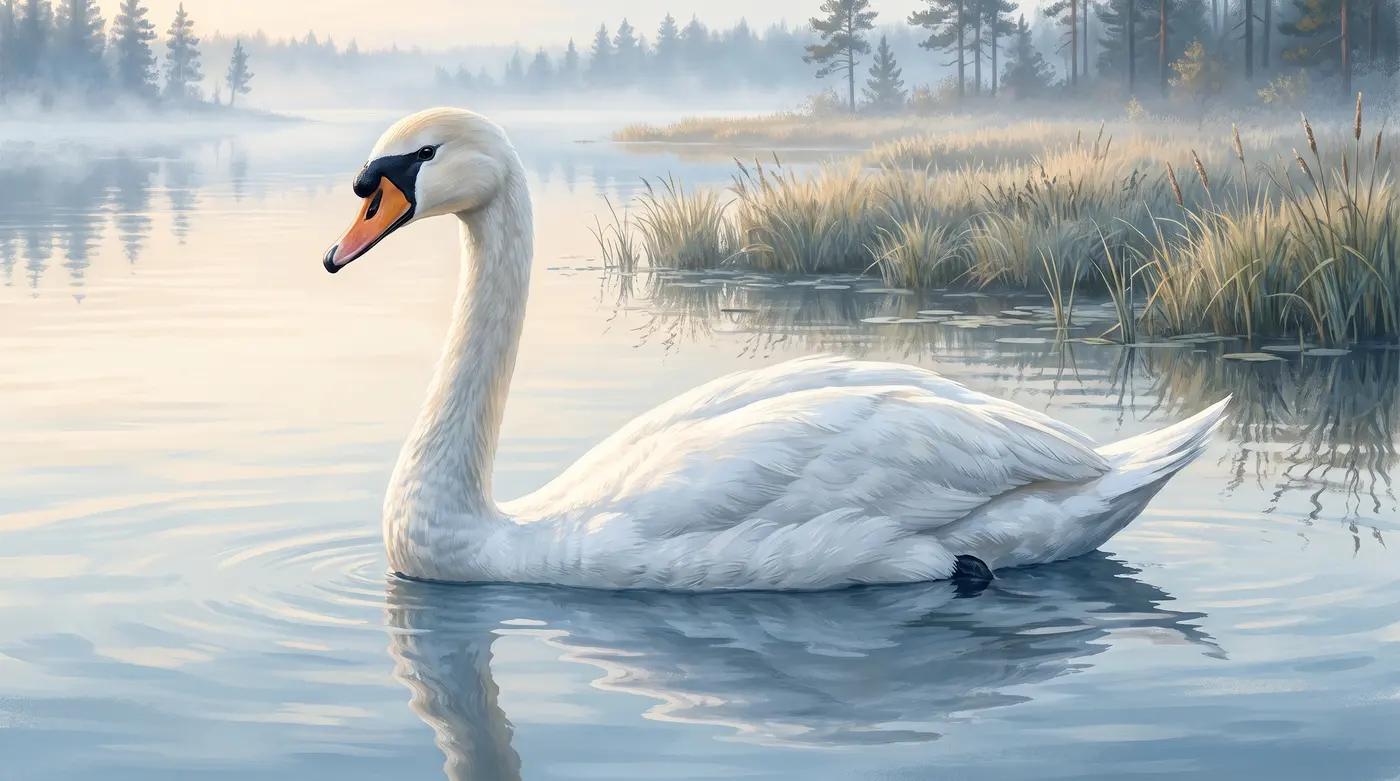
- Status: Safe
- Lakes, rivers, and canals of Europe, Asia, and North Africa
Numbers
- Weight
- 23 lbmale; female 18.5 lb
- Length
- 5,5 ftmale 5 to 6 ft, female 4.5 to 5.5 ft
- Lifespan
- 10 years10 to 20 years in the wild
- Wingspan
- 9 ftmale; female up to 8 ft
- Eggs per clutch
- 7 eggs5 to 7
- Incubation days
- 38 days34 to 38
Ten fun facts
an adult male swan weighs about twenty-three pounds, the female eighteen pounds, and the male wingspan can reach nine feet.
the swan is called mute because it produces only low guttural sounds that are difficult to hear from a distance.
when alarmed, the swan hisses like a cat, puffs up its wings, and pulls its neck back against its spine.
when relaxed, the swan swims using only one foot while resting the other on its back or under its wing.
the swan walks slowly because placing all its weight heavily on a webbed foot could injure the delicate foot tissue.
the swan uses its beak to spread waterproof oil from its preen gland onto feathers to make flight easier.
the swan has no teeth, so while taking food from your hand it might pinch, but it cannot bite.
the swan has poor vision straight ahead, so it turns its head sideways or tilts it down to focus.
two rival male swans can swim side by side in synchronized circles for long minutes before parting without fighting.
the swan nest is a platform of twigs rising over two feet above water to protect eggs from floods.
The quiz answers
The first one is the question printed in your book: here is the answer. The other four are extra.
Question 1 of 5★ this one is in your book
Why is the swan called the mute swan?
Question 2 of 5
What does the swan do when alarmed?
Question 3 of 5
How many eggs does the female lay on average?
Question 4 of 5
How does the swan make its feathers waterproof?
Question 5 of 5
At what age does the swan reach breeding maturity?
Try it yourself
Measure nine feet on the floor using a tape measure to see the wingspan of a male swan. Spread your arms wide and compare the difference.
Place a drop of oil on paper and one on a napkin, then pour water on both. You will see why the swan oiling its feathers stays dry.
Mark thirty-eight days on a calendar starting from today. This shows the maximum time a female swan spends incubating her clutch of large eggs.
Data from Wikidata (Q25402) and Wikipedia (Mute swan).